

Hashimoto’s Disease (Autoimmune Thyroiditis): The Role of HHV-6 and Other Herpesviruses
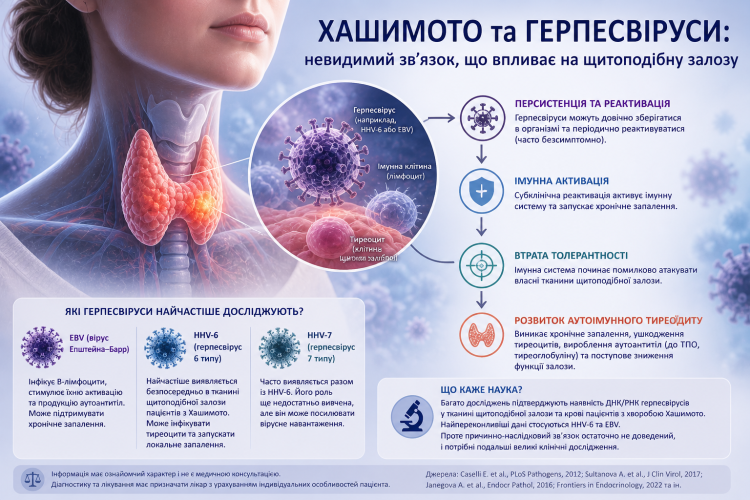
Hashimoto’s disease (autoimmune thyroiditis, AIT) is a chronic inflammatory disease of the thyroid gland in which the immune system mistakenly attacks the organ’s own tissue. Over time, this can lead to a gradual decrease in gland function and the development of hypothyroidism.
It is important to specify immediately: AIT and multinodular goiter are different conditions. In Hashimoto’s disease, the main mechanism is autoimmune damage to the tissue of the thyroid gland. With multinodular goiter, it is primarily about structural changes — the formation of nodes that can exist without an active autoimmune process. However, in real clinical practice, these conditions can combine: one person may have both nodular changes and signs of autoimmune thyroiditis.
In recent years, the issue has been actively discussed in the scientific literature: Can chronic viral infections, especially herpesviruses, be involved in triggering or maintaining Hashimoto’s disease?
Why did herpesviruses attract attention?
Herpesviruses are a large group of viruses that include Epstein-Barr virus (EBV), human herpesvirus types 6 and 7 (HHV-6, HHV-7), and cytomegalovirus (CMV). Their peculiarity is that after the initial infection they do not disappear from the body, and go into a latent state and can periodically reactivate.
Such reactivation is often fleeting subclinically — without a bright picture of an acute infection. However, even at low levels, the virus can continuously stimulate the immune system, disrupt immune regulation, and maintain chronic inflammation.
It is this mechanism that is considered as a possible background for the development or maintenance of autoimmune diseases, in particular Hashimoto’s autoimmune thyroiditis.
HHV-6: A virus found directly in thyroid tissue
The most convincing data to date have been obtained regarding human herpes virus type 6 (HHV-6), especially its HHV-6A variant.
A number of studies have shown that HHV-6 is detected directly in thyroid tissue from patients with autoimmune thyroiditis. Moreover, we are talking not only about fragments of viral DNA, but also about signs of an active viral infection.
In a 2012 study by Caselli et al., HHV-6 was detected in approximately 80% of patients with Hashimoto’s disease, whereas it occurred significantly less frequently in controls. It is especially important that the researchers found signs active viral transcription. This means that the virus was not just present in the tissue, but could show functional activity.
Other studies have also shown that HHV-6 can localize directly in the thyrocytes — cells of the thyroid gland. This is fundamentally important, as it reveals a possible mechanism by which the gland cells themselves become participants in immune inflammation.
It is assumed that HHV-6 can change the expression of HLA molecules on the surface of thyrocytes, increase the presentation of autoantigens, in particular thyroid peroxidase (TPO) and thyroglobulin, trigger local inflammation and contribute to the loss of immune tolerance.
From a pathogenesis perspective, this makes HHV-6 one of the most likely candidates for a role local viral cofactor of the autoimmune process in the thyroid gland.
EBV: systemic exposure through the immune system
Epstein-Barr virus (EBV) is treated somewhat differently. Its key feature is the ability to infect B-lymphocytes and persist in them for a long time.
Thanks to this, EBV can affect not only a single organ, but also the immune system as a whole.
Studies have shown that EBV is found in the thyroid tissue of a significant proportion of patients with Hashimoto’s disease. In some studies, the virus was found in more than 80% of patients, while it was not detected in control samples.
In addition, some patients with autoimmune thyroiditis have EBV DNA in their blood and signs of increased immune activation, including increased expression of Toll-like receptors (TLR3, TLR7, TLR9). These receptors are part of innate immunity and help the body recognize viral molecules.
Mechanisms of EBV effects may include B-cell activation, stimulation of autoantibody production, molecular mimicry—that is, the similarity of individual viral proteins to the body’s own proteins—as well as chronic stimulation of the innate immune response.
Thus, EBV can be seen rather as systemic immune modifier, which is able to support or enhance the autoimmune process.
The role of HHV-7 and other herpesviruses
Data on HHV-7 are currently much more limited. This virus is often co-detected with HHV-6 and may likely play a supporting role by enhancing overall viral load and immune activation.
Regarding cytomegalovirus (CMV), herpes simplex virus (HSV), and varicella zoster virus (VZV), their involvement in the pathogenesis of Hashimoto’s disease is much less well understood. To date, there is not enough convincing data about their leading role in autoimmune thyroiditis.
What does subclinical reactivation mean in this context
The key point of the modern concept is that it is not necessarily an acute infection with high fever, marked inflammation or typical symptoms.
The most likely model is a condition in which the virus is present in tissues or immune cells, is periodically activated at a low level, does not cause an obvious clinical picture, but constantly irritates the immune system.
It is this chronic, inconspicuous viral-immune load that can over time contribute to the disruption of immune regulation and the formation of autoimmune processes in genetically predisposed people.
As far as it is proven
Despite the abundance of interesting data, it is important to keep a critical eye.
Today we can say that the presence of HHV-6 and EBV in thyroid tissue has been confirmed in a number of independent works. Mechanisms through which these viruses can potentially affect immunity and support autoimmune inflammation are also described.
However, there is still a lack of large prospective studies and randomized clinical trials that could unequivocally prove the causal role of herpesviruses in the development of Hashimoto’s disease.
Therefore, at this stage, herpesviruses should be considered as significant cofactors, but not as the only or definitively proven root cause of the disease.
Practical conclusion
Current data suggest that Hashimoto’s disease may have a hidden infectious-immune component associated with persistence and subclinical reactivation of herpesviruses, primarily HHV-6 and EBV.
However, HHV-6 is probably more important at the level of the thyroid gland itself, while EBV affects the immune system more broadly through B-lymphocytes, autoantibody production, and mechanisms of chronic immune activation.
At the same time, standard treatment regimens for Hashimoto’s disease currently do not include antiviral therapy as a mandatory component. This question remains a promising area of research, but needs further verification.
Sources
Caselli E. et al. Human herpesvirus 6 infection and Hashimoto’s thyroiditis. PLoS Pathogens, 2012.
https://doi.org/10.1371/journal.ppat.1002951
Sultanova A. et al. Active HHV-6 infection in thyroid tissue. Journal of Clinical Virology, 2017.
Janegova A. et al. Epstein–Barr virus and autoimmune thyroid diseases. Endocrine Pathology.
Frontiers in Endocrinology, 2022. Viral infections and thyroid autoimmunity.
https://www.frontiersin.org/articles/10.3389/fendo.2022.938633
RSU Study, 2024. Presence of EBV, HHV-6, HHV-7 in thyroid tissue.
Polish study, 2024. EBV DNA and TLR activation in Hashimoto’s.
Disclaimer: This material is for informational purposes only and does not constitute medical advice, diagnosis, or treatment recommendations. The information does not replace a doctor’s examination. Diagnosis, interpretation of analyzes and treatment should be carried out by a qualified medical specialist, taking into account the individual characteristics of the patient.
 АС
АС