

Cold Sore or Canker Sore: How to Tell the Difference and When Treatment Helps
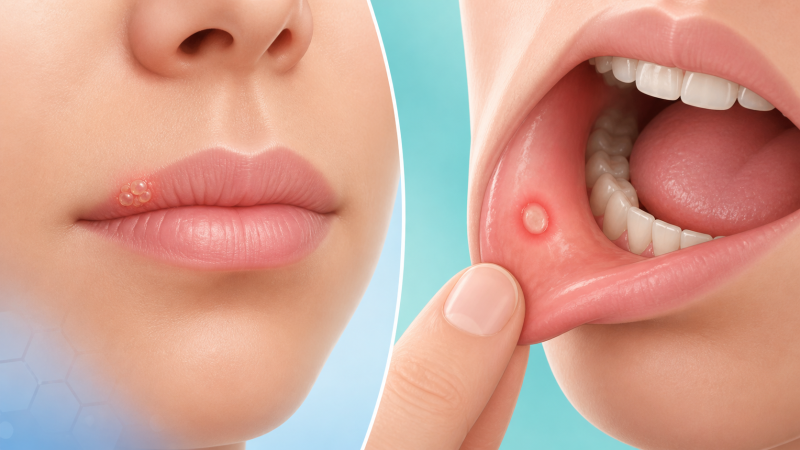
A painful spot near the lip or inside the mouth often raises the same question: “Is this herpes?” But a cold sore and a canker sore are not the same. They look different, have different causes, and call for different care. The most important everyday distinction is that a cold sore caused by herpes simplex virus can spread to another person, while an ordinary canker sore cannot.
A diagnosis cannot always be made from appearance or a photo alone. If a lesion is unusual, very painful, keeps returning, or does not heal, show it to a clinician or dentist.
The short answer: where is it and how did it start?
A cold sore most often appears on the outer edge of the lip or nearby skin. Hours or days before the eruption, there may be tingling, itching, or burning. One or more small, grouped, fluid-filled blisters then appear. They may break, form a shallow ulcer, and crust over.
A canker sore usually develops inside the mouth—on the inner lip or cheek, or on the tongue. It is often a single round or oval ulcer with a pale center and a red rim. It is usually not preceded by a cluster of blisters, and a crust does not form on the moist lining of the mouth. The NHS emphasizes that ordinary mouth ulcers are not contagious and should not be confused with cold sores.
Location is helpful, but it is not a perfect rule. A first symptomatic HSV-1 infection can cause fever, painful gums, and many sores inside the mouth. Recurrent oral herpes can also occur on oral surfaces less often. Multiple blisters, severe pain, or systemic illness therefore need an assessment rather than self-diagnosis.
Why cold sores come back
Oral herpes is most often caused by HSV-1. After infection, the virus remains inactive in nerve cells and can reactivate from time to time. According to the World Health Organization, possible triggers include another illness or fever, sun exposure, menstruation, injury, emotional stress, and surgery. A recurrence does not mean poor hygiene or that anyone is to blame.
Canker sores are not caused by HSV. A single ulcer may follow a cheek bite, irritation from a sharp tooth, hot food, or another minor injury. Recurrent or multiple canker sores are sometimes associated with medicines, nutritional deficiencies, or other conditions, but their cause should not be assumed from appearance alone.
When antiviral treatment actually helps
Most mild recurrent cold sores in people without immune suppression resolve on their own. The HSE clinical guideline reviewed in March 2026 does not recommend routinely prescribing oral antiviral drugs to otherwise healthy people with cold sores. Clinicians may consider episodic tablets when recurrences are severe, frequent, or persistent, particularly when a person reliably recognizes the early tingling stage.
Timing matters. WHO says treatment for a recurrent episode is most effective when started within 48 hours of symptom onset, while the HSE guideline advises starting indicated episodic therapy during the prodrome, before blisters appear. Acyclovir, valacyclovir, and famciclovir can reduce the duration and severity of symptoms, but they do not remove latent virus from the body.
Do not use someone else’s leftover tablets or repeat an old regimen without checking. The choice of medicine depends on kidney function, pregnancy, age, immune status, and other medicines. If outbreaks regularly disrupt your life, discuss an advance plan for early treatment or, in selected cases, suppressive therapy with a clinician.
What you can do at home
- Do not pick blisters or scabs; wash your hands after accidental contact.
- For pain, ask a pharmacist whether acetaminophen/paracetamol or ibuprofen is safe for you.
- Drink enough fluids and temporarily avoid acidic, salty, or spicy foods if they worsen pain.
- If sunlight triggers outbreaks, use a broad-spectrum ultraviolet-protection lip balm.
- Do not burn the lesion with alcohol, acid, or concentrated salt: irritation does not treat HSV and can delay healing.
For a canker sore, soft foods, cool drinks, gentle oral hygiene, and avoiding irritants are usually sufficient. A pharmacist or dentist can suggest a local pain-relieving or anti-inflammatory treatment. HSV antivirals do not treat an ordinary canker sore.
How to reduce HSV-1 transmission
The NHS considers cold sores contagious from the first tingling until the lesion has completely healed. During this period:
- do not kiss and avoid oral sex;
- do not kiss babies: neonatal herpes is rare but dangerous;
- do not share lip balm, lipstick, utensils, or other items that have touched saliva;
- wash your hands before and after applying treatment, and avoid touching your eyes.
HSV-1 can sometimes spread when no symptoms are visible, but transmission risk is highest when a sore is active. Complete healing lowers risk, although it does not make the risk absolutely zero.
When you need an examination
Seek same-day medical care if blisters or pain occur near an eye, or if you develop eye redness, light sensitivity, or a change in vision. Do not put cold-sore cream or steroid eye drops into the eye unless specifically prescribed.
Do not delay advice if:
- you have atopic dermatitis and blisters are spreading over the skin;
- your immune system is weakened by illness, chemotherapy, transplantation, or immunosuppressive medicine;
- there is high fever, painful swollen gums, many mouth sores, or an inability to drink enough;
- the lesion is very large, unusual, extremely painful, or has not healed after two weeks;
- outbreaks are frequent or substantially affect quality of life.
The American Academy of Dermatology specifically recommends medical care for a sore near the eye, multiple or persistent sores, eczema, and weakened immunity. A canker sore inside the mouth should be assessed by a dentist or clinician if it lasts longer than three weeks, bleeds, becomes increasingly red or painful, or looks different from previous ulcers.
Sources
- WHO: Herpes simplex virus
- HSE: Recurrent cold sores guideline, 2026
- NHS: Cold sores
- NHS: Mouth ulcers
- American Academy of Dermatology: Cold sores — diagnosis and treatment
 АС
АС