

Herpesviruses and Joint, Enthesis, Tendon and Back Pain: When Are They Linked?
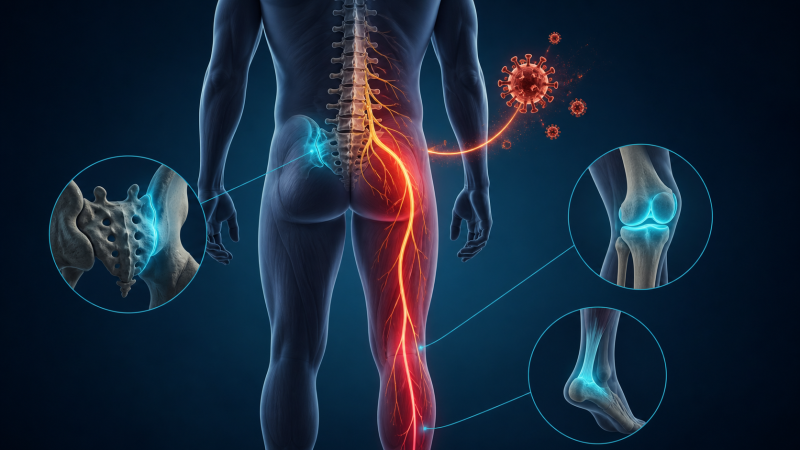
In brief: herpesviruses can cause pain, but the strongest direct link is nerve injury from herpes zoster (VZV) and rare lumbosacral radiculitis caused by HSV-2 or VZV. Acute EBV or CMV infection can sometimes include joint pain, while persistent enthesitis, tendinopathy, or chronic back pain is far more often due to another condition. A positive herpesvirus IgG result shows previous exposure; it does not prove that the virus is causing today’s pain.
Pain “around a joint” may arise from the synovium, a tendon, an enthesis—the point where a tendon or ligament attaches to bone—a muscle, a nerve root, or bone itself. These structures require different treatment. The first clinical question should therefore be not “which virus was detected?” but “which tissue hurts, and is there objective inflammation?”
The pain pattern helps identify its source
- Synovitis or arthritis: the joint is swollen or warm and movement is painful and restricted; morning stiffness may be prolonged. This differs from arthralgia, meaning pain without demonstrated joint inflammation.
- Tendinopathy: localized pain along a tendon that predictably worsens with a specific load or resisted movement.
- Enthesitis: tenderness at an attachment site, such as the heel, plantar fascia, patella, elbow, or pelvis. Persistent or multisite enthesitis without obvious overload raises concern for spondyloarthritis.
- Neuropathic or radicular pain: burning, shooting, electric-shock sensations, numbness, tingling, or skin pain from light touch. This is the pain pattern most characteristic of VZV.
- Inflammatory back pain: younger onset, duration longer than three months, night pain, morning stiffness, and improvement with movement rather than rest; buttock pain, enthesitis, psoriasis, uveitis, or inflammatory bowel disease may coexist.
When a herpesvirus can be the direct cause
VZV (HHV-3): the strongest evidence concerns nerve involvement
After chickenpox, VZV remains latent in sensory ganglia. Reactivation inflames the corresponding nerve and skin. Pain may be aching, burning, stabbing, or shock-like and can include allodynia—pain caused by clothing or light touch. Clusters of blisters usually appear a few days later on one side of the body in one or two adjacent dermatomes and generally do not cross the midline. Pain can precede the rash, and occasionally no rash appears at all, a presentation called zoster sine herpete. According to the CDC, postherpetic neuralgia—pain lasting more than 90 days in the former rash area—develops in about 10–18% of people with shingles.
If VZV reactivates in a lumbosacral root, pain can be felt in the lower back, buttock, groin, thigh, or leg and be mistaken for a hip, sciatic nerve, or tendon problem. The process is mainly radiculitis or neuralgia, not enthesitis or joint destruction.
HSV-1/HSV-2: rare meningoradiculitis
HSV, particularly HSV-2, rarely causes acute lumbosacral radiculitis known as Elsberg syndrome. Concerning features include severe sacral or radicular pain with saddle numbness, leg weakness, urinary retention or incontinence, or bowel dysfunction. Genital vesicles may be present but are not required. A systematic review of 19 published cases from 2000–2023 found HSV and VZV as the main pathogens, but the small number of reports illustrates how uncommon the syndrome is. New bladder dysfunction, saddle anesthesia, or progressive weakness requires urgent assessment—not self-directed antibody testing.
EBV (HHV-4) and CMV (HHV-5): occasional arthralgia during acute infection
A systemic immune response during primary EBV or CMV infection can cause muscle and joint pain and, less often, true arthritis. The context is usually acute: fever, marked fatigue, sore throat and lymphadenopathy with EBV, or characteristic changes in the complete blood count or liver enzymes. Isolated chronic Achilles enthesitis or low-back pain without evidence of an acute illness is not a typical presentation.
EBV is also studied as a possible contributor to autoimmune diseases including rheumatoid arthritis, systemic lupus erythematosus, and Sjögren disease. Proposed mechanisms include molecular mimicry, persistent B-cell stimulation, and altered immune regulation. A population-level association and a plausible mechanism do not, however, establish EBV as the cause of one person’s symptoms. A rheumatic disease is diagnosed by its own clinical criteria, not by an EBV-IgG titre.
HHV-6 and HHV-7: many hypotheses, little clinical certainty
HHV-6/7 have been investigated in postviral fatigue, diffuse pain, and several immune conditions. There is no validated syndrome of “HHV-6 enthesitis” or “HHV-7 tendinitis,” and data on chronic musculoskeletal pain are inconsistent. Clinically important HHV-6 reactivation is best described in people with profound immunosuppression, especially after hematopoietic stem-cell transplantation, where encephalitis and other organ disease may occur. Those observations cannot automatically be applied to an immunocompetent person with heel or back pain.
HHV-8 is mainly relevant to Kaposi sarcoma and certain lymphoproliferative disorders; it is not a routine explanation for enthesitis or mechanical pain.
How a virus might trigger or maintain pain
- Direct nerve inflammation. This is best established for VZV and, less often, HSV. An injured nerve may continue to generate pain after active viral replication has ended.
- Acute systemic immune response. Cytokines and other mediators can cause arthralgia and myalgia during infection; that does not mean the virus is inside the joint.
- Postinfectious immune activation. An infection can precede an autoimmune or reactive process, but causality requires separate evidence.
- Molecular mimicry and B-cell activation. These are important research models for EBV, but not yet tests that determine chronic pain treatment.
- Pain-system sensitization. The nervous system can remain hypersensitive after an acute episode. The pain is real even when active viral replication is no longer present.
What resembles reactivation—and what does not
There is no universal set of “reactivation signs” for all herpesviruses. For VZV, a new unilateral dermatomal pain, tingling, or itching with the characteristic vesicular rash—or rarely without it—is suggestive. For HSV, the clues are typical recurrent localized blisters or a documented neurologic syndrome. Clinically important EBV, CMV, or HHV-6 reactivation is generally assessed in special settings such as profound immunosuppression, transplantation, or organ disease, and symptoms are correlated with quantitative PCR trends.
Fatigue, brain fog, low-grade temperature, migratory pain, stress, or a temporary post-exertional flare are nonspecific by themselves. They may accompany infection but also sleep disorders, anemia, thyroid disease, fibromyalgia, autoimmune disease, depression, and many other conditions.
Diagnosis: from tissue and syndrome to a targeted test
1. Examination and localization
The clinician looks for joint swelling and warmth, restricted movement, tendon and enthesis tenderness, muscle strength, reflexes, sensation, and the distribution of pain. Relevant context includes the relationship to load, morning stiffness, waking at night, rash, psoriasis, uveitis, inflammatory bowel disease, recent infection, medications, and immune status.
2. Basic tests and imaging guided by the hypothesis
A complete blood count, CRP/ESR, liver tests, or creatine kinase may be appropriate, but none “confirms viral pain.” Ultrasound can demonstrate synovitis, tenosynovitis, or enthesitis; sacroiliac MRI is used when axial spondyloarthritis is suspected. NICE recommends rheumatology referral for persistent or multisite enthesitis without an apparent mechanical cause, particularly when unexplained back pain, psoriasis, uveitis, inflammatory bowel disease, or relevant family history is present.
3. Viral tests only when the result answers a specific question
- VZV: when a rash is present, PCR from vesicle fluid, cells from the lesion base, or a crust is most useful. The CDC emphasizes that serology has limited value for confirming shingles; a single positive IgG does not confirm reactivation.
- HSV/VZV with neurological symptoms: neurological examination, MRI, and often cerebrospinal-fluid PCR are required in hospital—not a blood “panel.”
- EBV: suspected primary infection is interpreted using VCA IgM, VCA IgG, and EBNA together. According to the CDC, VCA IgM without EBNA supports primary infection; VCA IgG with EBNA usually indicates past infection. More than 90% of adults have EBV antibodies, and high levels may persist for years.
- CMV: IgM/IgG, avidity, or PCR is selected according to illness timing, pregnancy, and immune status; incidental CMV-IgG does not explain chronic enthesitis.
- HHV-6: quantitative PCR is mainly useful in specialist settings. Chromosomally integrated HHV-6 can cause persistently high DNA levels without active infection. ECIL guidance describes confirmation through the ratio of viral copies per cell or detection in hair follicles or nails.
- HHV-7: routine testing for musculoskeletal pain rarely changes management.
Practical rule: test the right specimen, at the right time, for the right syndrome. Broad “herpes panels,” repeated IgG titres, or PCR without a clinical question create false causal stories and may delay the correct diagnosis.
How to distinguish more common causes
- Mechanical overload or tendinopathy: clear relationship to repetitive movement or training, focal tenderness, and worsening with load; fever, rash, and a dermatomal neurological pattern are usually absent.
- Spondyloarthritis: inflammatory back pain, night waking, improvement with movement, heel enthesitis, dactylitis, psoriasis, uveitis, or inflammatory bowel disease. Normal CRP or a negative HLA-B27 result does not rule it out.
- Rheumatoid arthritis: persistent symmetric synovitis of small joints and prolonged morning stiffness; RF and anti-CCP are interpreted with the examination, not instead of it.
- Crystal or septic arthritis: a suddenly hot, swollen, extremely painful joint. Septic arthritis can occur without fever and requires urgent aspiration. The SANJO guideline stresses that no blood test alone can reliably exclude it.
- Other viral arthritides: when true acute arthritis dominates, parvovirus B19, hepatitis B/C, HIV, or—after travel—chikungunya are usually more relevant. A Clinical Medicine review estimated a viral cause in about 1% of investigated acute arthritis cases and recommends epidemiologically targeted testing.
- Medication and systemic causes: fluoroquinolones can injure tendons; statins may cause myalgia; hypothyroidism, anemia, deficiencies, sleep disorders, and fibromyalgia may cause diffuse pain. For more on diffuse pain, see our article on fibromyalgia, myositis, and herpesviruses.
When urgent care is needed
- a suddenly hot, red, swollen joint, especially with chills or systemic illness;
- new urinary retention or incontinence, saddle numbness, or progressive leg weakness;
- severe back pain with fever, immunosuppression, recent infection, trauma, or cancer history;
- rash and pain around the eye, visual change, red eye, or photophobia;
- widespread vesicular rash or neurological symptoms in an immunocompromised person.
Will antivirals help?
Acyclovir, valacyclovir, and related drugs have established indications for specific acute HSV/VZV syndromes. They are not standard treatment for chronic tendon, enthesis, or back pain based on positive IgG. Even in postherpetic neuralgia, once active replication has ended, treatment is directed mainly at neuropathic pain rather than indefinite viral suppression.
If arthritis, spondyloarthritis, tendinopathy, radiculopathy, or fibromyalgia is confirmed, that condition should be treated. Antiviral therapy is prescribed when the clinical syndrome and evidence of active infection fit, with attention to timing, kidney function, interactions, and risks.
Bottom line
Herpesviruses can cause or trigger pain, but the evidence is uneven. VZV and rare HSV/VZV radiculitis produce a characteristic neuropathic, dermatomal, or radicular pattern. Acute EBV/CMV infection can include arthralgia, while EBV’s role in initiating autoimmunity remains a complex association rather than a personal diagnosis. Evidence linking HHV-6/7 to chronic enthesitis or tendinopathy is insufficient.
The safest approach is to identify the pain source first, look for objective inflammation or nerve injury, exclude dangerous and more common causes, and only then order a narrowly targeted viral test. This prevents both missed rheumatic or infectious disease and unnecessary treatment of a “reactivation” that is not actually present.
This article is for information only and does not replace medical assessment.
Sources
- CDC: Clinical Features of Shingles.
- CDC: Laboratory Testing for Varicella-Zoster Virus.
- CDC: Laboratory Testing for Epstein-Barr Virus.
- Elsberg syndrome in HSV and VZV infection: systematic review.
- Marks M, Marks JL. Viral arthritis. Clinical Medicine. 2016.
- Epstein-Barr virus as a potentiator of autoimmune diseases. 2024.
- ECIL guidelines for HHV-6 after hematopoietic stem-cell transplantation.
- NICE NG65: Spondyloarthritis in over 16s.
- SANJO guideline for septic arthritis in native joints.
 АС
АС