

An Immune System That Does Not Switch Off: How Chronic Immune Activation Is Linked to Viruses, Autoimmunity and Fatigue
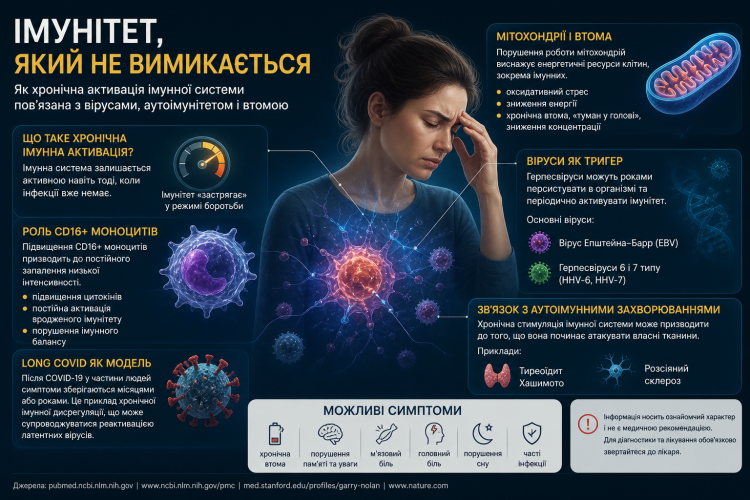
Modern medicine increasingly recognizes that many chronic conditions—from persistent fatigue to autoimmune diseases—may be associated not with a single organ, but with impaired regulation of the immune system.
One area that helps explain these processes is the research of Stanford University immunologist Garry Nolan, devoted to chronic immune activation and its consequences.
What “an immune system that does not switch off” means
Normally, the immune system works like a well-tuned mechanism: it becomes activated in response to an infection and returns to a state of balance after the infection has been eliminated.
However, in some people this process is disrupted. The immune system remains activated even when there is no longer an obvious acute infection. This condition is called chronic immune activation.
In simple terms, the body appears to be “stuck” in fight mode.
The role of CD16+ monocytes: a marker of hidden inflammation
Nolan’s work has shown that some patients with chronic symptoms have an increased number of so-called CD16+ monocytes—immune-system cells involved in inflammatory responses.
This is accompanied by:
- increased levels of pro-inflammatory cytokines
- continuous activation of innate immunity
- disruption of immune balance
This condition may remain unnoticed in standard tests for years.
Mitochondria and fatigue: the energy-related aspect of the problem
Another important field is the study of immune-cell metabolism.
It has been shown that chronic immune activation is associated with:
- impaired function of mitochondria (the cell’s energy-producing structures)
- increased oxidative stress
- reduced ability of cells to recover
This may explain symptoms such as:
- chronic fatigue
- “brain fog”
- reduced concentration
Viruses as a trigger: the role of herpesviruses
Special attention should be paid to viruses capable of persisting in the body for a long time.
These include:
- Epstein–Barr virus (EBV)
- human herpesviruses types 6 and 7 (HHV-6, HHV-7)
These viruses can remain in cells for years and periodically activate the immune system without causing a pronounced clinical picture.
Under these conditions, a vicious cycle can form:
viral persistence → immune activation → exhaustion → even greater reactivity
Long COVID as a model of the process
After the COVID-19 pandemic, it became clear that symptoms persist for months or years in some people.
This condition, known as Long COVID, is considered an example of chronic immune dysregulation.
A number of studies have shown that it may be accompanied by reactivation of latent viruses, including EBV.
Association with autoimmune diseases
Chronic stimulation of the immune system may cause it to begin attacking the body’s own tissues.
This is one of the possible mechanisms involved in the development of conditions such as:
- Hashimoto’s thyroiditis
- multiple sclerosis
The immune system loses its ability to clearly distinguish “self” from “non-self.”
Why standard tests are often “normal”
Many patients face a situation in which symptoms are present while test results remain within the normal range.
This is because standard methods are not always able to detect subtle immune abnormalities.
Modern technologies such as mass cytometry (CyTOF) make it possible to see much deeper changes, but they are not yet widely available in routine practice.
Conclusion
Chronic activation of the immune system is a complex, multifactorial process that may underlie many conditions that are difficult to diagnose.
Understanding these mechanisms helps us view chronic symptoms in a new way and find a more comprehensive approach to their assessment.
Sources
- https://pubmed.ncbi.nlm.nih.gov/
- https://www.ncbi.nlm.nih.gov/pmc/articles/
- https://med.stanford.edu/profiles/garry-nolan
- https://www.nature.com/
The information presented in this article is for educational purposes only and is not medical advice or a substitute for consulting a physician. Always consult a qualified healthcare professional when making decisions about diagnosis and treatment.
 АС
АС