

Hidden Herpesvirus Activity: From Fatigue to Systemic Diseases
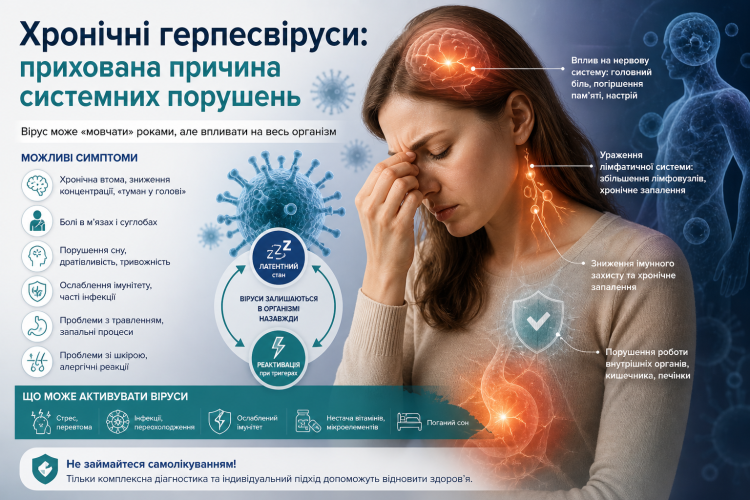
Chronic Herpesviruses: A Hidden Cause of Systemic Disorders
In recent years, more and more people have been experiencing conditions that are difficult to explain within the framework of standard clinical practice:
- persistent fatigue
- low-grade fever
- headaches and reduced concentration
- immune instability
- neurological and psycho-emotional symptoms
In many cases, such conditions remain without a clear diagnosis or receive generalized explanations such as “stress,” “overwork,” or “autonomic dysfunction.”
At the same time, increasing attention is being paid to a factor that has long been underestimated — the reactivation of herpesviruses, primarily:
- Epstein–Barr virus (EBV, HHV-4)
- Human herpesvirus type 6 (HHV-6)
- Human herpesvirus type 7 (HHV-7)
Why This Topic Is Becoming Relevant
Virtually the entire adult population is infected with these viruses. However, the key factor is not the presence of infection itself, but the transition of the virus into an active state.
Modern conditions create a background for reactivation:
- chronic stress
- sleep disturbances
- post-viral states
- prolonged inflammatory processes
- immune imbalances
As a result, viruses that were previously in a latent phase begin to show activity and become involved in systemic processes within the body.
What Happens During Reactivation
Herpesviruses have the ability to persist long-term in the body and interact with key systems — the immune and nervous systems.
During reactivation, systemic processes are triggered:
Immune Dysregulation
The balance of the immune response is disrupted — ranging from exhaustion to pathological hyperactivation.
Chronic Inflammation
Including at the level of the central nervous system (neuroinflammation).
Energy Metabolism Disruption
Mitochondrial dysfunction develops, accompanied by weakness and reduced endurance.
Short-Term Manifestations
In early stages, this may present as:
- chronic fatigue
- low-grade fever
- impaired concentration
- headaches
- increased sensitivity to stress
These symptoms are often perceived as nonspecific, but it is at this stage that the further progression of the process is formed.
Long-Term Risks and Systemic Consequences
With prolonged persistence and reactivation of herpesviruses without proper evaluation and management, deeper systemic disturbances may develop.
Modern research increasingly considers these viruses as one of the factors potentially involved in the development of complex chronic conditions.
Autoimmune Diseases
Viral reactivation may act as a trigger or sustaining factor for autoimmune processes.
The scientific literature discusses associations with conditions such as:
- systemic lupus erythematosus
- multiple sclerosis
- autoimmune thyroiditis
- rheumatic diseases
Proposed mechanisms include molecular mimicry, chronic immune activation, and dysregulation of immune responses.
Neurological and Neurodegenerative Processes
Herpesviruses exhibit tropism for nervous tissue and are capable of maintaining long-term neuroinflammation.
In recent years, their potential role has been actively studied in:
- cognitive decline
- chronic neuroinflammatory conditions
- neurodegenerative diseases, including Alzheimer’s disease
There is a hypothesis that viral persistence may be one of the factors that initiate or exacerbate degenerative processes in the central nervous system.
Chronic Systemic Syndromes
Long-term viral activity may contribute to the development of persistent pathological conditions:
- chronic fatigue syndrome (ME/CFS)
- persistent autonomic dysfunction
- reduced adaptive capacity of the organism
This is accompanied by a combination of immune dysregulation, chronic inflammation, and energy deficiency.
Important Clarification
The presence of herpesviruses alone does not necessarily mean the development of severe diseases.
However, in the presence of symptoms, signs of reactivation, and a prolonged course without a systemic approach, the risk of developing chronic and more serious conditions increases.
What Truly Matters
The key is not simply detecting the virus, but understanding its role in the current state of the body:
- whether the process is active
- which systems are involved
- which mechanisms have already been triggered
- which strategy is justified
Approach to Management
Effective management of such conditions requires a systematic analysis:
- assessment of symptoms and their dynamics
- evaluation of viral activity
- immunological profiling
- identification of key pathogenetic mechanisms
- development of a personalized strategy
About the Project
This resource is an analytical platform that brings together:
- scientific data
- clinical observations
- practical approaches
The goal is to help form a comprehensive understanding of the condition and define a rational course of action.
Where to Start
A rational starting point includes:
- obtaining structured information
- analyzing one’s own situation based on symptoms and test results
Within this resource, materials are available that help build an understanding of underlying processes and allow for deeper analysis when needed.
 АС
АС