

Herpesviruses and the Nervous System: Diagnosis and Treatment
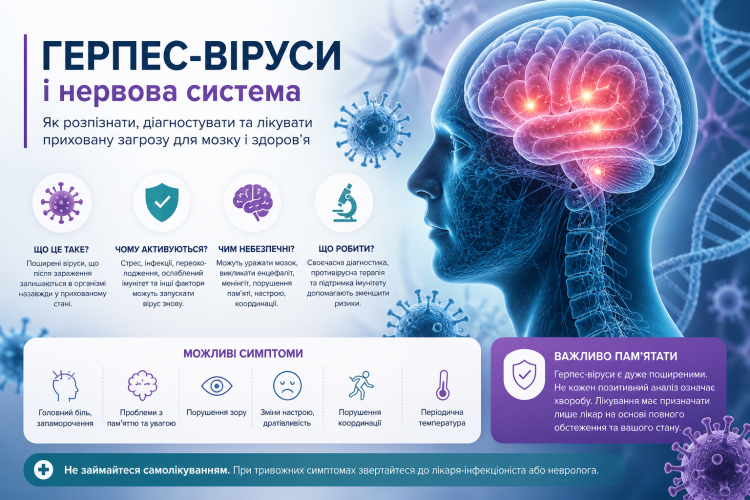
Herpesvirus infections belong to the most common human viral infections. Most people are infected with them in childhood or adolescence, after which the virus does not disappear completely, but remains in the body in a latent state.
In most cases, this is not a serious problem. However, under certain conditions — after stress, severe infection, immune exhaustion, hypothermia, chronic inflammation, or against the background of immunodeficiency — herpesviruses can reactivate. That is why this topic remains important not only for infectious disease specialists, but also for neurologists, immunologists, rheumatologists and general practitioners.
Special attention is drawn to situations when herpesviruses involve the nervous system. In such cases, symptoms may not be obvious, diagnosis may be difficult, and consequences may be long-lasting.
What are herpesviruses and why they stay with us for a long time
The herpesvirus family includes herpes simplex virus types 1 and 2, varicella and herpes zoster viruses, Epstein–Barr virus, cytomegalovirus, HHV-6, HHV-7, and HHV-8. They differ in clinical manifestations, but have a common feature: after the initial infection, they are able to persist in the body for life.
This is called latency. In simple words, the virus seems to “fall asleep” in certain cells and tissues. For example, HSV-1 often resides in nerve ganglia, EBV in B-lymphocytes, and HHV-6 can be associated with immune cells and nervous tissue. However, latency does not always mean complete inactivity. In some people, the virus can be periodically or chronically active, especially if immune control is weakened.
That is why herpes virus infections cannot be considered only as a “rash on the lips”. In some patients, they may be associated with damage to the mucous membranes, lymph nodes, liver, eyes, lungs, immune system, and central nervous system.
Why herpesviruses can affect the nervous system
Some herpesviruses are neurotropic — the ability to penetrate nerve tissue or persist near nerve structures. The most famous example is the herpes simplex virus, which can cause herpes encephalitis. This is one of the most dangerous viral brain lesions.
For HSV encephalitis, damage to the temporal lobes and structures of the limbic system is typical. These areas of the brain are involved in memory, emotions, behavior, response to stress and partly in neuroimmune regulation. Therefore, after a herpetic lesion of the brain, a person may not only have a headache or weakness, but also problems with memory, concentration, speech, mood and general endurance.
At the same time, not every detection of herpesvirus DNA means an active neuroinfection. This is a very important point. PCR results should be evaluated in conjunction with symptoms, MRI, CSF analysis, and the patient’s general condition.
What symptoms can be alarming
Acute damage to the nervous system is usually evident. A person may have a high temperature, severe headache, confusion, seizures, slurred speech, weakness in the limbs, loss of consciousness, or a sudden change in behavior. In such cases, urgent medical assistance is required.
However, there is another problem: some patients after an acute infection or chronic reactivation describe less dramatic but debilitating symptoms. These can be prolonged weakness, headache, “fog in the head”, memory impairment, instability, dizziness, periodic low-grade fever, lymph node tenderness, muscle and joint pain.
Such symptoms do not automatically prove a herpesvirus cause. However, they may prompt further investigation, especially if there is a combination of neurological manifestations, signs of immune imbalance, frequent recurrent infections, or an unexplained chronic inflammatory condition.
Why is diagnosis so difficult?
The main difficulty is that herpesvirus lesions of the nervous system do not always have one “classic” picture. Encephalitis can mimic a stroke, tumor, psychiatric disorder, autoimmune process, or other infectious disease.
Therefore, the modern approach to diagnosis is based not on one analysis, but on three key points: clinical picture, neuroimaging and laboratory confirmation. In other words, the doctor has to assess what is going on with the patient, what is seen on the MRI or CT, and whether there is evidence of an active infection in the cerebrospinal fluid or blood.
The analysis of the cerebrospinal fluid — cerebrospinal fluid — is of particular importance. When encephalitis is suspected, PCR for HSV-1/2, VZV, enteroviruses, and other pathogens is often performed. In some cases, it is also important to determine the intrathecal synthesis of antibodies — that is, the production of antibodies directly in the central nervous system.
For example, with VZV vasculopathy, the PCR of the cerebrospinal fluid can be negative, especially if the process does not last the first day. In such situations, the detection of antibodies to VZV in the cerebrospinal fluid may be of greater diagnostic value. Therefore, a negative PCR does not always completely exclude a herpesvirus lesion, if the clinical picture is convincing.
What examinations may be required
When herpesvirus damage to the nervous system is suspected, basic diagnostics may include brain MRI, cerebrospinal fluid analysis, PCR for neurotropic viruses, serological studies, general blood analysis, biochemistry, inflammatory markers, and immunological examination.
In addition, an EEG may be required for seizures or unconsciousness, an ophthalmological examination for visual symptoms, ultrasound or MR angiography of vessels for suspected vasculitis or vasculopathy, as well as consultation with a neurologist and an infectious disease specialist.
It is important to understand: blood tests for IgG to herpes viruses by themselves often only show that a person once met with the virus. For the adult population, this is a normal situation. Therefore, high IgG without clinic, PCR activity or other signs is not a sufficient reason for aggressive treatment.
Treatment: what is known today
If herpes encephalitis is suspected, treatment is not delayed until the diagnosis is fully confirmed. In international recommendations, intravenous acyclovir remains the first-line drug for HSV encephalitis. This is fundamentally important, because early initiation of therapy significantly affects the prognosis.
Valacyclovir and famciclovir are more often used in less severe forms of herpesvirus infections or as an oral continuation of therapy in certain clinical situations. Ganciclovir or valganciclovir is considered primarily when CMV or HHV-6 is involved, especially in immunosuppressed patients, posttransplantation, or severe systemic involvement.
However, antiviral drugs have an important limitation: they act mainly on the active replication of the virus. They do not “remove” the virus from the body completely and do not guarantee the absence of relapses in the future. That is why in difficult cases it is important not only to suppress the virus, but also to look for the reason why the immune system does not control the infection properly.
Pathogenetic therapy may include control of cerebral edema, anticonvulsants, correction of inflammation, maintenance of fluid and electrolyte balance, treatment of concomitant bacterial infections, rehabilitation, and restoration of cognitive function. But the specific scheme always depends on the diagnosis, the severity of the condition, the virus, the age of the patient, the function of the kidneys, liver and immune status.
Why relapses remain a problem
One of the main problems of herpes virus infections is that even after a correctly conducted course of treatment, the virus can remain in the body. If immune disturbances, chronic inflammation, deficiencies, autoimmune activity, or other triggers persist, the risk of reactivation remains.
That is why the modern view of herpes virus infections is gradually shifting from the simple scheme “found a virus – gave an antiviral drug” to a broader approach. It is necessary to evaluate not only the virus, but also the organism in which it was activated: the state of the immune system, the presence of co-infections, chronic inflammatory processes, deficiencies, autoimmune manifestations and neurological consequences.
This is especially important for EBV, HHV-6 and HHV-7. These viruses are often in the “grey area” of clinical practice: they may be associated with immune and neurological disorders, but their role is not always easily proven by standard methods.
What this topic means for the patient
For the patient, the most important conclusion is simple: herpesvirus infections can be much more complicated than the usual recurrence of a rash. If a headache, cognitive impairment, prolonged weakness, unexplained fever, neurological symptoms, or sudden deterioration of well-being appear after an infection or against the background of a chronic condition, it should not be attributed only to fatigue or stress.
At the same time, it is equally important to avoid the other extreme. Positive antibodies to herpes viruses do not mean that they are the cause of all symptoms. Many people will be IgG positive for EBV, HSV, CMV, or VZV throughout their lives. Therefore, the decision on treatment should be based not on one indicator, but on a set of data.
When you need to apply urgently
Immediate medical attention is required if confusion, convulsions, sudden severe headache, high fever with neurological symptoms, slurred speech, weakness on one side of the body, loss of consciousness, severe drowsiness or sudden change in behavior occur.
Such symptoms may correspond to encephalitis, meningoencephalitis, stroke, vasculitis or another dangerous condition. In this situation, home surveillance is unacceptable.
Conclusion
Herpesvirus infections remain one of the most complex topics of modern infectious diseases. Their prevalence is very high, but the clinical significance depends on the specific virus, the state of the immune system, the localization of the process and the evidence of active replication.
The most dangerous are lesions of the central nervous system, in particular encephalitis, meningoencephalitis and virus-associated vasculopathy. In such cases, early diagnosis, MRI, analysis of cerebrospinal fluid, PCR, assessment of intrathecal antibodies and timely initiation of therapy are crucial.
However, in chronic and “hidden” cases, an even broader view is needed. It is worth evaluating not only the virus, but also the immune background, co-infections, autoimmune manifestations, deficiencies and neurological consequences. It is this approach that makes it possible not to lose the patient between separate specialties and not to reduce a complex systemic problem to a single analysis.
Importantly: This article is informative and educational in nature and does not constitute medical advice, diagnosis or treatment. Herpesvirus lesions of the nervous system can be dangerous and require an eye assessment by a doctor. Any decisions regarding antiviral therapy, immunosuppression, cerebrospinal fluid puncture, MRI, or other tests should be made with a qualified medical professional.
Sources
1. Andreeva O.G., Muravska L.V., Dyachenko P.A., Hetman L.I., Rudenko A.O. Modern problems, diagnosis and treatment of herpesvirus infections. Actual infectology. 2020;8(3). View source
2. Tunkel A.R. et al. The Management of Encephalitis: Clinical Practice Guidelines by the Infectious Diseases Society of America. Clinical Infectious Diseases. View source
3. Management of Suspected Viral Encephalitis in Adults. Association of British Neurologists / Encephalitis Society. View source
4. Herpes Simplex Encephalitis. StatPearls / NCBI Bookshelf. View source
5. Grzonka P. et al. Unveiling the clinical spectrum of herpes simplex virus CNS infection. 2025. View source
6. Wu D. et al. Varicella-zoster virus vasculopathy: a rare complication of varicella-zoster virus reactivation. Frontiers in Neurology. 2025. View source
 АС
АС