

Fibromyalgia, Myositis and Herpesviruses: A Hidden Link Worth Investigating
For a long time, fibromyalgia remained one of those diagnoses that seem to exist, but are not fully explained.
A person can live for years with the feeling that the body is constantly “on the edge”: various muscle groups hurt, exhaustion sets in quickly, sleep does not bring recovery, and it becomes increasingly difficult to concentrate. At the same time, examinations often look quite normal, and a clear reason for such a condition cannot be found. That is why such cases are often attributed to functional disorders related to the work of the nervous system.
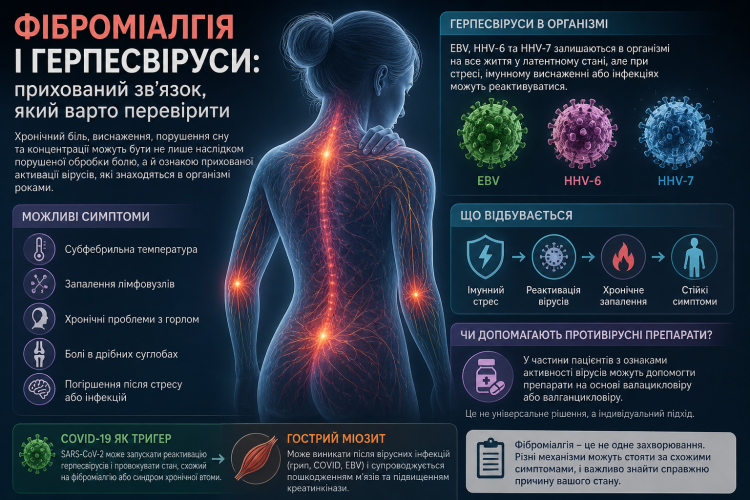
But if you take a closer look, it becomes obvious: not everyone has this condition in the same way. In some people, signs are added to the main symptoms that are difficult to explain only by the features of pain perception. It can be an unstable low temperature, periodic enlargement of lymph nodes, lingering problems with the throat, discomfort in small joints, as well as noticeable deterioration after stress or previous infections. At such moments, another question naturally arises: is there not a deeper process hidden behind this, which remains outside the boundaries of standard diagnostics?
One hypothesis that has received increasing attention in recent years is related to herpesviruses, primarily Epstein-Barr virus (EBV), as well as HHV-6 and HHV-7. The peculiarity of these viruses is that they remain in the body for life. In most people, they are in a latent state and do not cause problems. But under certain conditions—stress, immune depletion, hormonal changes, or acute infections—they can reactivate.
This reactivation often does not look like an acute infection. A person does not have classic signs of a viral disease, but at the same time, a condition is gradually formed that is very similar to fibromyalgia: constant fatigue, pain in muscles and joints, “fog in the head”, unstable temperature, feeling that the body is not recovering. That is why the concept of partial or subclinical reactivation is increasingly being discussed in the literature.
There is work showing that patients with fibromyalgia have higher levels of HHV-6 and HHV-7 DNA in their blood, and in some cases, signs of active infection that are not present in healthy people. There is also an increase in pro-inflammatory cytokines and a connection with damage to small nerve fibers. This is an important point, because precisely such fibers are responsible for the transmission of pain and temperature signals. Their damage can create a feeling of deep, debilitating pain that is difficult to describe and even more difficult to treat.
After the COVID-19 pandemic, this topic has become even more relevant. There have been many observations that SARS-CoV-2 can act as a trigger for the reactivation of EBV and other herpesviruses. And some people develop a condition that is practically no different from fibromyalgia or chronic fatigue syndrome after COVID. In this case, it is not just about the consequences of a viral infection, but about a complex cascade: immune stress → loss of control over latent viruses → chronic inflammation → persistent symptoms.
Another interesting aspect is acute myositis, which sometimes occurs after viral infections. This is already a more “physical” manifestation, when the muscles are really damaged, which is confirmed by an increase in creatine kinase. This condition is well described after influenza in children, but now it is increasingly observed after COVID, as well as with EBV infection. In most cases, it goes away on its own, but sometimes it can be part of a more complex inflammatory or immune process.
The following question logically arises: if some patients have a viral component, can antiviral drugs help? Here the situation is ambiguous. For classic fibromyalgia, such evidence is not yet sufficient.
But in a broader group of patients with chronic fatigue syndrome or postviral conditions who have evidence of EBV or HHV-6 activity, some studies show improvement with valacyclovir or valganciclovir therapy. At the same time, this is not a universal solution and not a standard treatment, but rather a direction for an individual approach.
At the same time, it is worth understanding that even without influencing a possible viral factor, some patients manage to reduce symptoms due to symptomatic therapy. Most often, we are talking about drugs from the group of antidepressants (for example, fluoxetine), which can affect the perception of pain and the level of exhaustion, although the exact mechanism of their action in fibromyalgia is not fully understood.
Less standard approaches are also discussed separately. Currently, these methods are not included in generally accepted protocols and require further study, however, in clinical practice and individual observations, they sometimes demonstrate a reduction of symptoms in some patients.
As a result, it becomes obvious that fibromyalgia is not a single disease, but rather a syndrome, behind which different mechanisms can be. And if for some patients the nervous system plays a key role, then for others — immune dysregulation and, possibly, reactivation of viruses. That is why in such cases it is important not to stop at a formal diagnosis, but to try to understand the deeper cause of the condition.
 АС
АС